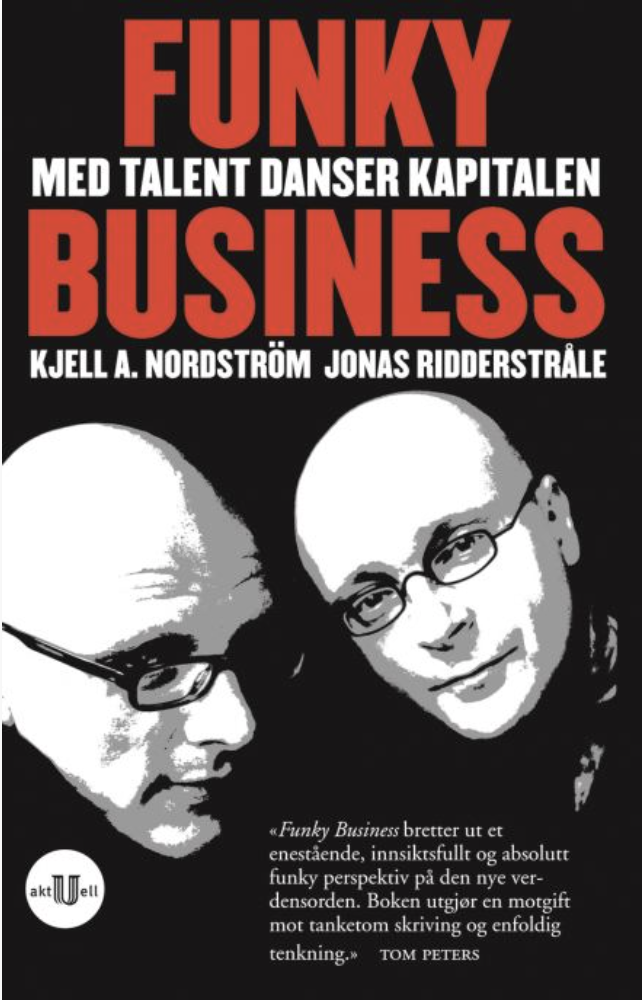
“Funky Business” is a book written by Kjell Nordstrom and Jonas Ridderdale, two economics professors at Stockholm University. When it was published in the early 2000s, the book caused a sensation. It heralded the dawn of e-commerce, promising a libertarian world brimming with opportunity. Addressing themes of creativity, organizational upheaval, and chaos, “Funky Business” bridges the gap between technology and emotional intelligence—a topic so widely discussed today—in 2024. Talent makes capital dance.
So, you might ask, “So what?” Well, this title reminded me, back when I was living in Watford, UK, that work could be “funky”—that is, bring rhythm, humor, and boldness to it… even a touch of irreverence! When I started reading this book while working at Hilton Corp’s headquarters in England, I began drafting a memo for the VP of Marketing, Tim Davis. In it, I explained that we needed to inject more “funk” into our work, even a bit of madness, to create even bolder marketing campaigns and innovations.
I was young, a bit of a daredevil, and reading “Funky Business” had given me a real buzz. And yet, that night, in that dilapidated apartment on Vicarage Road, I thought for the first time that it would be better to wait until after the night had passed before sending such a memo to my superior. Had I grown up that night? Where had that “funky attitude” I’d wanted to instill gone? The next morning, I reread my memo and congratulated myself for not having sent it 🙂.
Was I wrong? Who knows. It’s up to you: how much “funkiness” would you like to spread in your organizations?
Nova Train® – Keep searching
Epilogue – 7 years later: However, this idea stayed with me. A few years later, while working in Brussels at the Radisson Hotel Group headquarters, John Kennedy, Jacques Dubois, and I won the award for best communication campaign at the 7th Freddie Awards in 2007 with the campaign “We’ve been sleeping together for a while, now it’s time to say you love me.” The Freddie Awards are an international competition for frequent flyer programs of airlines, hotels, and car rental companies, voted on by frequent travelers. The “funky business” effect had taken hold; the time it took for ideas to percolate was quite long.